19th June 2023 in Construction, Press releases, Project news, Supply Chain

- Largest offshore jack-up vessel and first seaworthy ultra-low emission installation vessel Voltaire arrives in the UK for her very first assignment on Dogger Bank Wind Farm.
- The vessel will install turbines for all three Dogger Bank Wind Farm phases, a total of 277 units of GE Renewable Energy Haliade-X offshore wind turbines.
The largest offshore jack-up installation vessel ever built, Voltaire, has just arrived in the UK port of Able Seaton ahead of its first campaign on Dogger Bank Wind Farm.
Voltaire of Jan De Nul Group was delivered in late 2022. Since then she has been undertaking final preparations for her very first assignment, the construction of the Dogger Bank Wind Farm phases A, B and C.
In total, the vessel will be responsible for installing 277 GE Renewable Energy Haliade-X turbines. Voltaire will sail out in early July to begin installation
Olly Cass, Dogger Bank Wind Farm Project Director, said:
“As offshore wind technology grows in scale and power, the industry needs stronger vessels that are capable of meeting these engineering challenges. With its lifting capacity of more than 3,000 tonnes and ultra-low emissions design, we can’t wait to see this next generation vessel take on the challenge of installing some of the world’s largest and most powerful turbines, as we head towards first power for Dogger Bank A this summer.”
Jan Van Impe, Manager Jan De Nul Offshore Renewables, said:
“Dogger Bank Wind Farm is exactly the type of project we had in mind when we took the decision to build our Voltaire. The scale and characteristics of the offshore Dogger Bank turbines offer the perfect challenge for this next generation state-of-the art jack-up installation vessel. We are excited to continue our contribution to the energy transition together with industry leaders SSE Renewables, Equinor and Vårgrønn by installing the offshore wind turbines at Dogger Bank A, B and C in the most efficient and clean manner possible.”
Voltaire is the first seaworthy installation vessel to be an Ultra-Low Emission vessel
Voltaire, named after the pioneering European Enlightenment philosopher, has a lifting capacity of over 3,000 tonnes.
The vessel is fitted with a highly advanced exhaust filtering system by means of a selective catalytic reduction system and a diesel particulate filter, making her the very first seagoing installation vessel of her kind to be an Ultra-Low Emission vessel (ULEv), moreover Stage V-certified.
Picture caption: The offshore jack-up installation vessel Voltaire is the largest of her kind in the world and is able to install the next generation of offshore wind turbines starting with the Dogger Bank wind turbines of +13MW and 14MW. Image credit: Jan De Nul
2nd June 2023 in Construction, Project news, Supply Chain

The Correll Group’s electrical engineering division has been awarded a contract by DEME Offshore to complete inter-array cable termination and testing on 95 wind turbines and the offshore substation platform on the first phase of Dogger Bank Wind Farm.
The Cleveland-head-quartered firm in the north-east of England, is one of a number of UK companies helping to support the safe installation and testing of critical marine equipment for the world-leading project.
DEME previously awarded contracts to Darlington-based Tekmar and Proserv’s Great Yarmouth Centre of Excellence team for the delivery of cable protection and cable monitoring systems.
More than 2,000 UK based jobs are being created or supported in relation to the construction and operation of , including over 400 long-term jobs that have been created locally in the north-east of England to support operations and maintenance from South Tyneside for the 35-year life of the wind .
It’s anticipated DEME’s contract with Correll will support around 50 skilled UK-based jobs.
Sam Dowey, Managing Director at Correll, said:
“We are delighted to have been awarded this contract from Deme Offshore, also extremely proud to be delivering works for a local wind farm utilising local content.”
Dogger Bank Wind Farm marine package manager, Alan Evans, said:
“Correll Group will play an important role in the safe installation and testing of sub-sea equipment in preparation for first power this summer.
“They will join a number of UK-based firms helping to build the critical marine infrastructure needed for this world-leading project including the manufacturers of our cable protection and cable monitoring systems.”
20th April 2023 in Construction, Project news

- Dogger Bank Wind Farm will be first UK High Voltage Direct Current (HVDC) connected offshore wind farm
- 70% reduction in topside weight per MW for offshore platforms
Construction of what will be the world’s largest offshore wind farm, Dogger Bank, has reached another milestone with the installation of the world’s first unmanned High Voltage Direct Current (HVDC) offshore substation.
The substation is the first of three platforms, supplied by Aibel, to be installed at Dogger Bank, which is being constructed in three 1.2GW phases known as A, B and C.
The Dogger Bank A platform measures 65 x 36 metres across and 39 metres high and sits on a four-legged steel jacket foundation structure which is fixed to the seabed, at a water depth of around 28m.
Approximately 146km from the nearest point of land at Flamborough Head, near Bridlington in East Riding of Yorkshire, the platform installation was delivered by principal contractor Sapiem.
The innovative offshore platform has a lean design and is the first unmanned HVDC platform which will be operated from shore and accessed only by a Service Operations Vessel. The platform will receive 1.2GW of AC power from Dogger Bank A’s 95 offshore wind turbines and convert it to DC, which will then be sent ashore to an onshore convertor station near Beverley in East Riding of Yorkshire.
Fitted with Hitachi Energy’s latest generation HVDC converter technology, Dogger Bank will be the first offshore wind project in the UK to use this technology to transmit the electricity produced back to shore, ensuring that the electricity is transmitted efficiently over long distances while minimising losses.
Olly Cass, Project Director for Dogger Bank Wind Farm, said:
“The safe and successful installation of the offshore platform marks a major milestone in the Dogger Bank project. As the UK’s first HVDC platform for an offshore windfarm it is also a major milestone for the UK industry more widely.
“The platform will be controlled from shore and by removing the need for personnel to stay on the platform meant it has been possible to eliminate elements such as the living quarters, helideck and sewage systems, resulting in a 70% reduction in weight (per megawatt) of the topside compared to previous platforms installed, and cost savings of hundreds of millions of pounds.
“Teams continue to make good progress with the installation of turbine foundations and later in Q2 specialist cable installation and support vessels will start to install the inter-array network of cables that will connect the turbines to the offshore platform to enable transmission of first power in the summer.”
Dogger Bank Wind Farm, a joint venture between SSE Renewables, Equinor, and Vårgrønn, is set to be the world’s largest offshore wind farm consisting of 277 wind turbines. The wind farm will be capable of of generating 3.6GW of renewable energy which is enough clean and sustainable electricity to power more than 6 million homes.
Ends
29th March 2023 in Construction, Project news

More than 80% of the ducts that will house the cables transmitting renewable energy from two offshore wind projects to the national electricity network has been installed in Teesside.
Working in cooperation, Sofia Offshore Wind Farm and Dogger Bank C, the third phase of Dogger Bank Wind Farm share onshore cable corridors and to minimise local disruption, have joined forces to have their cable ducts installed by the same contractor at the same time.
The projects are both located on Dogger Bank, more than 195 kilometres from the north-east coast of England, with their export cables coming ashore on Teesside, between Redcar and Marske-by-the-Sea.
Sofia is 100% owned by RWE, and Dogger Bank Wind Farm is a joint venture between SSE Renewables, Equinor and Vårgrønn. Although they are owned by different companies, the developers realised early that it made sense to work jointly on their shared cable corridor, with civil engineering works being carried out by J Murphy & Sons (JMS). Sofia is leading the works on behalf of both projects.
More than 80% of the ducts that will house the cables transmitting renewable energy via the national electricity network on Teesside from two offshore wind farm projects are now in the ground and trenches backfilled. Work is underway on one key section of the route that requires the ducts to be installed using tunnelling rather than by trenching or horizontal directional drilling. Shafts have been established and a micro-tunnel boring machine is now working 24/7 to create four tunnels under the railway line at Black’s Bridge/Redcar Road.
The projects’ high voltage direct current (HVDC) cables will be pulled through the ducts, 7 kilometres to two new converter stations now under construction on the Wilton complex to the north-east of Lazenby. The first of the cables will arrive in the summer to be pulled through the ducts.
Each project will have a further 2 km of high voltage alternating current (HVAC) cables to transmit the converted power to the existing National Grid substation at Lackenby, where it will enter the national electricity network for distribution to homes and businesses.
Dogger Bank Wind Farm onshore package manager Stephen Reynolds, said:
“We really appreciate the ongoing patience of the local community as our joint contractor continues to install this critical infrastructure in readiness for first power from Dogger Bank C in 2025.
“Some of our ongoing works near the beach landfall requires extended working hours during evenings and weekends as we progress the projects, but our contractors are committed to ensuring mitigation is in place to minimise disruption wherever possible.”
Elsewhere on the two projects’ work is ongoing at the landfall site near Marske-by-the-Sea, with horizontal directional drilling due to take place between March and May in preparation for receiving the first cables this summer.
There may be some evening, overnight and Sunday working required at this location, but contractors are committed to ensuring noise and disturbance is minimal.
And at the site adjacent to the Wilton complex, near Lazenby village, work continues on the construction of the projects’ onshore converter stations as the valve halls, control rooms and storage buildings start to take shape. Some Sunday working will be required for the remainder of the year to carry out elements of groundwork and electrical installation, with measures also being taken there to minimise disruption.
14th February 2023 in Construction, Press releases, Supply Chain
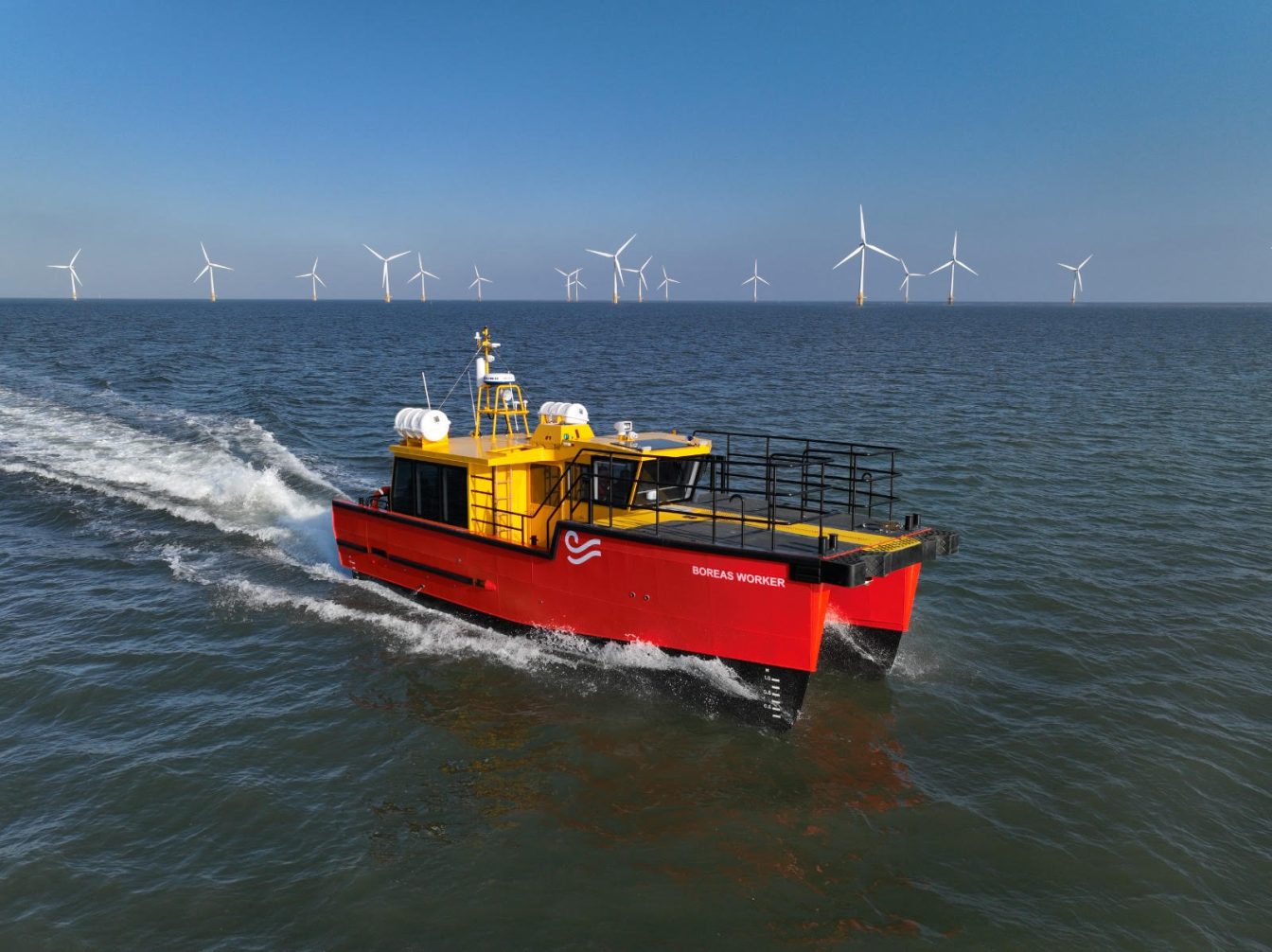
Edda Wind has launched a daughter craft crew transfer vessel (CTV) for use on Dogger Bank Wind Farm designed by UK-based industry pioneers Chartwell Marine.
The innovative new vessel has been built by Alicat Workboats Ltd and was named Boreas Worker. It was built on behalf of Astilleros Gondan SA before entering service for operator Edda Wind, as part of the firm’s contract during commissioning and construction of the first phase of Dogger Bank Wind Farm.
The 12-metre CTV, which will work in conjunction with Edda Wind’s fleet of hydrogen-ready commissioning service operation vessels (CSOVs), is the first of a new catamaran daughter craft design to be commissioned.
The Chartwell daughter craft responds to the need in the offshore wind support market for low-emissions, cost-effective vessels, with the catamaran’s optimised hull form offering efficient fuel use as well as stability and manoeuvrability in choppy waters.
Boreas Worker has a capacity of 12 personnel and is designed to be conveniently deployed from CSOVs and ‘floatels’ during extended offshore stays, offering wind farm technicians comfortable and efficient access to turbines, vessels, and other critical project infrastructure.
Dogger Bank Wind Farm, a joint venture between SSE Renewables, Equinor, and Vårgrønn, is set to be the world’s largest offshore wind farm. The three phases of the project, known as A, B, and C, will provide an overall total capacity of 3.6GW, capable of powering 6 million homes.
Boreas Worker will form a versatile addition to Edda Wind’s fleet as it supports Phase A of construction this spring.
Andy Page, Director of Chartwell Marine, said:
“The Daughter Craft fulfils a key role in a modern support vessel fleet – giving vessel operators a way to safely transfer engineers from rest-space to work-space while out at sea for longer periods of time, ultimately streamlining the processes of turbine commissioning and maintenance.
“We’re excited to be able to contribute our design expertise to an offshore energy project of this scale, and especially one off our own shores. We’d like to thank our partners at Edda Wind for choosing us to help get Dogger Bank built.”
Kenneth Walland, CEO of Edda Wind, said:
“Daughter craft workboats give more flexibility to our offshore wind operations in addition to the CSOV — and we need to ensure that we set the same standards of technical availability, efficiency, and performance across every vessel in our fleet. Chartwell’s proven track record bringing innovative small vessel designs into operation made them a clear choice of partner for this project. We are therefore pleased to launch the Boreas Worker, joining the Edda Boreas in supporting the construction of Dogger Bank.”
Dogger Bank Wind Farm Commercial Director, Simon Bailey, said:
“The UK-designed Boreas Worker vessel will be a welcome addition to our construction and commissioning fleet, providing safe and efficient transfers for our team as we install our first turbines this year.”