16th April 2025 in Community News

Dogger Bank Wind Farm has won another award for its work building a sustainable legacy in its key communities.
The project scooped the Community Impact Award in this year’s Northern Echo BUSINESSiQ awards.
Community investment manager for Dogger Bank Wind Farm, Kay Doragh, said:
“The level of excellence we are supporting around reaching primary schools, making STEM careers accessible, CPD for teachers and using creativity to inspire children is fantastic. The most important thing about social investment is that it has real impact – so I’m delighted to see this award recognise what our delivery partners are achieving in their local communities.”
In June 2024, Dogger Bank Wind Farm announced the next phase of its community fund, committing £25 million to be used in the North and North East of England throughout the operational phase of the wind farm.
The community fund will continue to be used to enhance science, technology, engineering, and maths (STEM) education for young people, equipping them with the skills to succeed in a net zero world.
The new community fund builds on the £1 million community fund set up during the construction phase of Dogger Bank, which has already supported more than 36,000 young people across 204 schools, provided 62 university scholarships, and provided 87 grants to local community groups.
In Redcar and Cleveland, the wind farm is investing in a primary school STEM careers programme that has helped more than 4,000 young people to learn about the opportunities available to them in a net zero world.
The programme is delivered by the Redcar and Cleveland Voluntary Development Agency (RCVDA), with strategic support from Redcar and Cleveland Council.
Programme co-ordinator for RCVDA Jacqui Hutchinson, said:
“This Community Impact Award couldn’t be more deserved and acknowledges the difference that Dogger Bank Wind Farm has affected in the lives of primary aged children in Redcar and Cleveland, by their embrace of an innovative partnership between the local authority, the voluntary sector, schools and the businesses in their supply chain, which has created a programme that has received national recognition.
None of this would have been possible without the tireless support of Kay, the wider Dogger Bank family, the businesses they work with, and last, but not least, the warm and open embrace we have received in the schools across the Borough, as we work together to overcome the disadvantage may young students face and build their confidence towards a brighter future.”
Further information about the Dogger Bank community fund and information on how to apply for grants and scholarships can be found here: www.doggerbank.com/about/community/
A full list of Dogger Bank’s accolades is available here https://doggerbank.com/about/our-awards/
11th April 2025 in Project news

Dogger Bank Wind Farm has submitted a request to the Department for Energy Security and Net Zero to amend the wording in its Development Consent Order, to allow for phases A and B of the project to progress separately through the OFTO sales process. As part of this application and in line with the Planning Act 2008, we have now opened a formal period of consultation with stakeholders on the proposed wording amendments.
Further details of this process are available in the Reg 6 notice below:
SECTION 153 OF THE PLANNING ACT 2008 REGULATION 6 OF THE INFRASTRUCTURE PLANNING (CHANGES TO, AND REVOCATION OF, DEVELOPEMNT CONSENT ORDERS) REGULATIONS 2011 NOTICE OF APPLICATION TO MAKE A NON-MATERIAL CHANGE TO THE FOLLOWING DEVELOPMENT CONSENT ORDER: THE DOGGER BANK CREYKE BECK OFFSHORE WIND FARM ORDER 2015 (AS AMENDED) (S.I. 2015/318)
REF: EN010021
- An application has been made by Doggerbank Offshore Wind Farm Project 1 Projco Limited (“Projco 1”) and Doggerbank Offshore Wind Farm Project 2 Projco Limited (“Projco 2”) (together the “Applicant”) to the Secretary of State for Energy Security and Net Zero to make a non-material change (“NMC”) to the above mentioned Development Consent Order (the “DCO”) (ref: EN010021).
- The DCO granted development consent to Doggerbank Project 1 Bizco Limited (“Bizco 1”) for “Project A” and Doggerbank Project 4 Bizco Limited (“Bizco 4”) for “Project B” – two offshore wind turbine generating stations each comprising up to 200 wind turbine generators and associated development in the Dogger Bank Zone and the East Riding of Yorkshire. Bizco 1 was renamed at Companies House as Projco 1, and Project A was renamed Dogger Bank A (herein “DBA”). Bizco 4 was renamed at Companies House as Projco 2 and Project B was renamed Dogger Bank B (herein “DBB”).
- The application seeks to make non-material changes to the drafting of the DCO by amending the wording of certain definitions, articles and paragraphs of schedules to allow DBA and DBB to be considered separately, and for the discharge and enforcement of each project’s relevant requirements to be distinct from the other project.
- The contact details of the Applicant are:
Doggerbank Offshore Wind Farm Project 1 Projco Limited and Doggerbank Offshore Wind Farm Project 2 Projco Limited at No. 1 Forbury Place 43 Forbury Road, Reading, United Kingdom, RG1 3JH.
5. Email contact is possible by contacting:
DoggerBankConsentsConsultations@sse.com.
6. The application documents and details of the changes proposed by this NMC Application are available for inspection, free of charge, at the “Documents” tab on the National Infrastructure Planning Portal’s Dogger Bank Creyke Beck page here: https://national-infrastructure-consenting.planninginspectorate.gov.uk/projects/EN010021
7. For general enquiries on how to obtain any of the documents or on the information contained within them, please contact the Applicant (DoggerBankConsentsConsultations@sse.com).
8. A free digital copy of the application documents can also be obtained from the Applicant using the contact details provided above. This will be available until the deadline for responses set out below closes. Alternatively, a paper copy can be obtained from the Applicant for a charge of £300.
9. Please send any representations about the application by email to the Planning Inspectorate at:
DBCreykeBeck@planninginspectorate.gov.uk
or in writing to:
Major Applications & Plans, The Planning Inspectorate, Temple Quay House, 2 The Square Temple Quay, Bristol BS1 6PN.
Please quote ‘Dogger Bank Creyke Beck’ on any correspondence. Any representations received by the Secretary of State in response to the consultation will be published on the Planning Inspectorate’s Infrastructure Planning Portal (https://national-infrastructure-consenting.planninginspectorate.gov.uk/) with all personal information removed.
10. The deadline for receipt of representations is 23:59 on 23 May 2025.
Doggerbank Offshore Wind Farm Project 1 Projco Limited and Doggerbank Offshore Wind Farm Project 2 Projco Limited
11th April 2025 in Construction, Press releases, Project news, Supply Chain
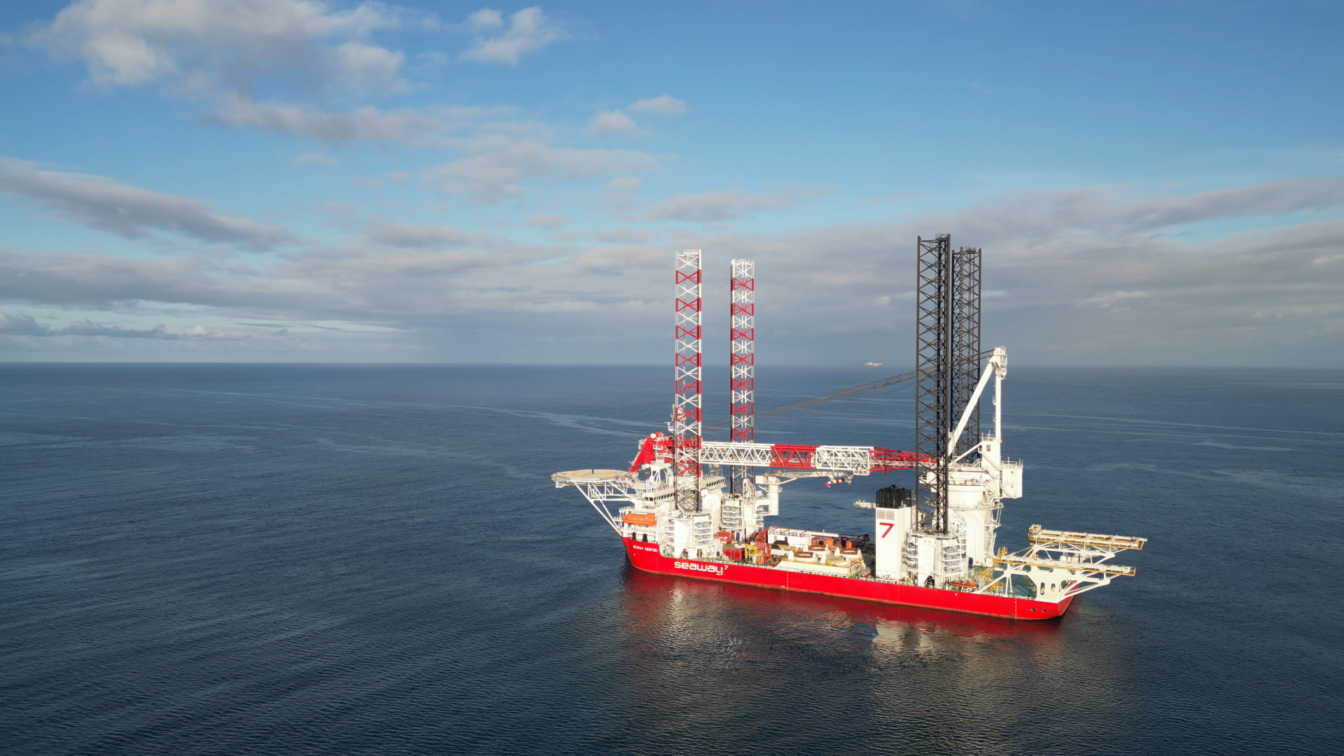
Dogger Bank Wind Farm has signed a contract with Seaway7, part of the Subsea7 Group, to charter a second turbine installation vessel to support the ongoing delivery of the offshore wind farm off the coast of England.
This contract signing follows on from the earlier reservation agreement between Dogger Bank Wind Farm and Seaway7, announced in December 2024.
Under the contract, the Seaway Ventus jack-up installation vessel will commence turbine transport and installation work of GE Vernova Haliade-X offshore wind turbines at the Dogger Bank site in mid-2026.
This contract represents additional work for Seaway7 at the Dogger Bank development where the company already has the contracts for transport and installation of the monopile foundations and transition pieces on all three phases of the project, with the works on Dogger Bank A complete and the works on Dogger Bank B substantially complete.
Turbine installation and commissioning work is continuing at Dogger Bank A, with completion of the first phase of the offshore wind farm expected in the second half of calendar year 2025.
When fully complete, Dogger Bank will be the world’s largest offshore wind farm, capable of powering around 6 million UK homes annually.
Dogger Bank Wind Farm is a joint venture between SSE Renewables (40%), Equinor (40%) and Vårgrønn (20%). SSE Renewables is leading construction of the project on behalf of the three joint venture partners. Equinor will be lead operator of the wind farm on completion for its expected operational life of around 35 years.
27th March 2025 in Uncategorised
Dogger Bank Wind Farm has submitted a request to the Department for Energy Security and Net Zero to amend the wording in its Development Consent Order, to allow for phases A and B of the project to progress separately through the OFTO sales process. As part of this application and in line with the Planning Act 2008, we have now opened a formal period of consultation with stakeholders on the proposed wording amendments.
Further details of this process are available in the Reg 6 notice below.
Doggerbank Offshore Wind Farm Project 1 Projco Limited and Doggerbank Offshore Wind Farm Project 2 Projco Limited at No. 1 Forbury Place 43 Forbury Road, Reading, United Kingdom, RG1 3JH.
- Email contact is possible by contacting:
DoggerBankConsentsConsultations@sse.com.
- The application documents and details of the changes proposed by this NMC Application are available for inspection, free of charge, at the “Documents” tab on the National Infrastructure Planning Portal’s Dogger Bank Creyke Beck page here:
https://national-infrastructure-consenting.planninginspectorate.gov.uk/projects/EN010021
- For general enquiries on how to obtain any of the documents or on the information contained within them, please contact Dorothee Neun at the Applicant (neun@sse.com or 0141 224 7248).
- A free digital copy of the application documents can also be obtained from the Applicant using the contact details provided above. This will be available until the deadline for responses set out below closes. Alternatively, a paper copy can be obtained from the Applicant for a charge of £300.
- Please send any representations about the application by email to the Planning Inspectorate at:
dbcreykebeck@planninginspectorate.gov.uk
or in writing to:
Major Applications & Plans, The Planning Inspectorate, Temple Quay House, 2 The Square Temple Quay, Bristol BS1 6PN.
Please quote ‘Dogger Bank Creyke Beck’ on any correspondence. Any representations received by the Secretary of State in response to the consultation will be published on the Planning Inspectorate’s Infrastructure Planning Portal (https://national-infrastructure-consenting.planninginspectorate.gov.uk/) with all personal information removed.
- The deadline for receipt of representations is 23:59 on 5 May 2025.
Doggerbank Offshore Wind Farm Project 1 Projco Limited and Doggerbank Offshore Wind Farm Project 2 Projco Limited
25th March 2025 in Supply Chain
Alicat Workboats is a specialised ship builder based in Great Yarmouth, England, that designs and constructs high-performance workboats. They are a supplier to the offshore wind industry, providing essential crew transfer vessels and other support craft. Beyond boat building, they offer a range of marine and engineering services, including vessel maintenance, repairs, and fabrication, catering to diverse needs within the maritime sector.
In our latest supplier case study video, learn from Simon Coote, Alicat Workboats General Manager, how Alicat are supporting the world’s largest offshore wind farm, Dogger Bank Wind Farm.