7th October 2024 in Press releases
- Members of the public are invited to have their say in the coming weeks on a potential fourth phase of Dogger Bank Wind Farm, Dogger Bank D.
- Consultation opens on Tuesday 10 September and is open until Tuesday 22 October
A public consultation into the Dogger Bank D wind farm proposals will begin on Tuesday 10 September, and run for six weeks ending on Tuesday 22 October 2024. The public consultation will feature local in-person events and an online Q&A session to gather feedback from the public.
Dogger Bank D is a potential new fourth phase of the Dogger Bank Wind Farm, the world’s largest offshore wind farm, which is currently under construction. Dogger Bank D would be located in the North Sea, around 210km off the Yorkshire coast and be capable of generating up to 2GW of renewable power. The consultation outlines introductory offshore and onshore proposals for the wind farm.
The consultation offers the community a chance to learn more about the project, ask questions and provide feedback. The project team encourages all feedback during this consultation phase, which will be accepted until midnight on Tuesday 22 October 2024. This input is important in helping to refine the plans for the project. A further phase of consultation is scheduled for 2025.
“We are excited to welcome the public to our consultation events for Dogger Bank D and provide the opportunity for the community to learn more about our proposals. It’s vital for those who live or work locally to be informed about our plans and we look forward to sharing our ideas with the community and listening to what they have to say”
Sophie Large, Senior Project Manager for Dogger Bank D
From Tuesday 10 September, project materials including the consultation brochure, maps and feedback forms will be available for download at www.doggerbankd.com. Consultation documents can also be requested directly from the project team by email or freephone or collected from community access points. For more information, please visit www.doggerbankd.com, call the freephone number on 0800 254 5029 or email contact@doggerbankd.com.
12th September 2024 in Community News, Press releases, Project news
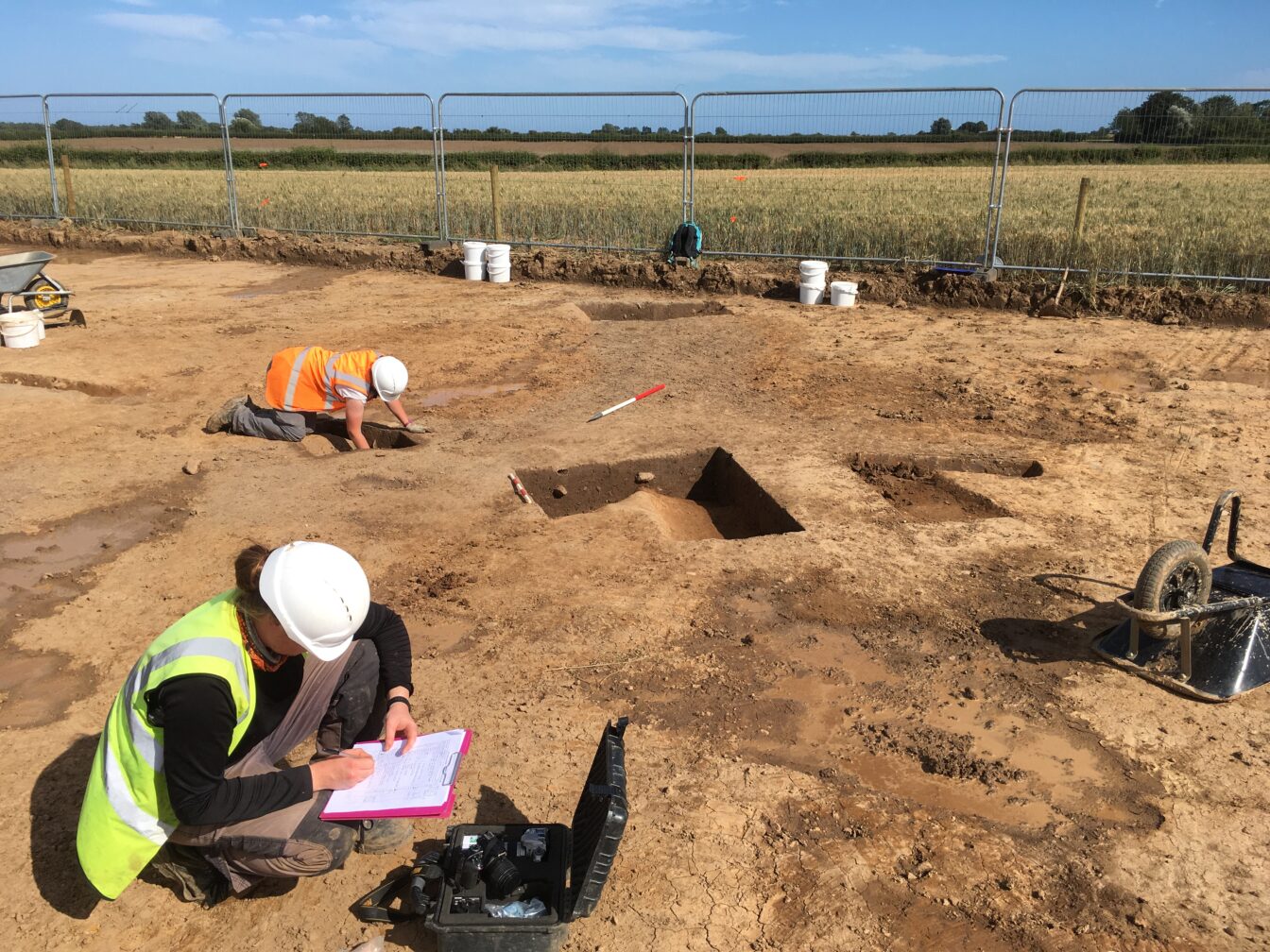
- Anglo-Saxon discoveries near Ulrome and Skipsea close to location where Anglo-Saxon timber hall was excavated by York University earlier this year.
- Dogger Bank discoveries indicate Anglo-Saxons settled in Holderness.
- Evidence of Bronze Age, Iron-Age and Roman presence also excavated during Dogger Bank work.
- Archaeologists to talk about their significant discoveries at public event in Ulrome on 20 September.
Archaeologists working on Dogger Bank Wind Farm will reveal at a public event next week how they unearthed significant evidence of Anglo-Saxon presence in Holderness.
The ground-breaking early medieval discoveries were unearthed by the archaeologists working on the 30km corridor that houses the underground cables transmitting renewable energy from Dogger Bank Wind Farm in the North Sea, to the wind farm’s two onshore convertor stations off the A1079 near Beverley.
These significant discoveries include remnants of an Anglo-Saxon long hall structure between Beeford and Skipsea, and an Iron-Age or Anglo-Saxon glass bead recovered from a site in Ulrome. The two sites close to Beeford produced the most evidence for Anglo-Saxon activity.
More radiocarbon dating of the activity on these sites is required, but at the moment an area of 5th-6th century activity associated with metalworking has been identified, close to a separate area where a long hall and field system ditches were recorded. The findings indicate Anglo-Saxons probably lived and farmed in this landscape over multiple phases between the 5th-11th centuries.
Radiocarbon dating is a scientific method for accurately determining the age of organic materials, by analysing the decay of radioactive isotopes. The developers of the windfarm have invested in this technique to ensure the project provides local communities and historians with accurate data about how the land was used hundreds of years ago.
Across the pipeline route archaeologists also discovered Iron Age and Roman evidence including well-preserved roundhouses in Ulrome, Beeford and Leven, a long-handled bone comb in Leven and significant amounts of handmade and wheel-thrown pottery.
It has long been clear the Holderness area was inhabited by the Anglo-Saxons due to the names of the towns and villages in the area, many of which incorporate Anglo-Saxon elements. Over recent years archaeological evidence has begun to emerge of Anglo-Saxon activity in the landscape, and the findings near Beeford add significantly to an emerging picture of Anglo-Saxon life in the region, greatly enhancing understanding of the period in Holderness.
The evidence for domestic and industrial activity that was unearthed at the sites, which has been evaluated and confirmed by medieval specialists, is of particular importance and significance.
Since the excavations at Beeford, a team of experts from York University has excavated a nearby site in Skipsea, further confirming the presence of Anglo-Saxons in the local area, centuries ago.
Community Engagement Manager for Dogger Bank Wind Farm, Rachel Lawrence, said:
“Safeguarding historical evidence has been a critical part of our preparation work on Dogger Bank Wind Farm. We’re delighted we’re now able to share these exciting findings with the people who live in the towns and villages where this work was undertaken.
“As well as the multi-million pound investment Dogger Bank Wind Farm is making to support its key coastal communities, this work will add to the legacy we’ve created during the construction of the world’s largest offshore wind farm.”
The work was completed by Dogger Bank Wind Farm contractor AOC Archaeology, and their analysis has been supported by a wide team of artefact and period specialists.
Dogger Bank Wind Farm has commissioned the production of replicas of some of the artefacts for educational purposes, and is set to share these with the public for the first time next week.
Representatives from the wind farm and AOC Archaeology will present the findings at a public event at Rickaby Village Hall in Ulrome, at 6pm on 20 September.
After the public event the replicas will be made available for local schools, to bring local history to life in the classroom. They include handmade replicas of a 6,000-year-old flint arrowhead, an Iron Age or Anglo-Saxon glass bead, an Iron Age to Roman bone comb and pottery that is thought to date back more than 2,000 years.
An online exhibition is also set to be launched later this year, giving the public access to a wealth of information about AOC’s work in the East Riding of Yorkshire.
During the Ulrome event AOC experts will share insight into the process of excavating and preserving historical artefacts, and describe the moment they realised they were on the verge of a regionally-significant discovery.
Project Manager for AOC Archaeology, Rebecca Jarosz- Blackburn, said:
“For me the most surprising and rewarding discovery on this project was the Anglo-Saxon long hall and associated field systems we recorded near Beeford, which represents some of the most extensive evidence from the period in the Holderness region.
“Since then it’s exciting to see further evidence from the period emerge, including the recent discovery of another Anglo-Saxon long hall in Skipsea by researchers from York University.
“Together our work on Dogger Bank Wind Farm and this work by York University is adding significant bodies of evidence like Anglo-Saxon pottery, metalwork and industrial materials in a region where Anglo-Saxon evidence has historically been quite sparse.
“Anglo Saxon discoveries of this kind are really interesting, because they give an opportunity to look at the everyday lives of people from the period – including how they farmed and interacted with the landscape. Unlike a cemetery site, where you might find the brooches and more precious items, if you can identify an Anglo-Saxon farming or settlement site you get a rare chance to investigate more of the reality of life in the period.”
Rickaby Village Hall was chosen for this event due to its proximity to the wind farm’s landfall point at Ulrome, where the wind farm’s sub-sea cables meet the onshore cables, for onward transmission to the convertor stations near Beverley. An Iron Age or Anglo-Saxon glass bead that forms part of the school education pack was also unearthed in the village of Ulrome.
The event is supported by Lissett and Ulrome Parish Council.
A second event is set to be held at a location further on in the 30km cable corridor at a future date to be confirmed.
AOC Project Manager Matt Walker, who grew up in East Yorkshire, also has a local connection to the Dogger Bank project. He said:
“One of the exciting outputs of the projects has been the volume of pottery coming out of our ditches – from some sites (including near Leven) there were wheelbarrows full of pottery.
“The region is known for producing Iron Age to Roman pottery so this is not a surprise, and to date the pottery we have typologies giving date ranges based on the fabrics and styles etc.
“At Dogger Bank, one of our main research aims was to try and narrow the current date ranges for handmade prehistoric and Roman pottery in the region by using radiocarbon dating.
“It is the scale of this project across the region, coupled with funding for radiocarbon dates, that gives us a really meaningful opportunity to add to this research theme and advance our understanding of Holderness thousands of years ago.
“What we found in and around Burshill was the core of an Iron Age to Roman settlement that would not have been uncovered without this net zero development.
“There are more artefacts that we’re still analysing and we hope to provide further information about them as our understanding becomes clearer.”
AOC and Dogger Bank Wind Farm are currently considering options for permanently locating the original artefacts once they’ve been fully analysed, with a preference to find a home close to where they were unearthed.
Set to be the world’s largest offshore wind farm once complete, Dogger Bank is situated over 130km from the Yorkshire coast and will produce enough renewable energy to supply electricity to six million homes in the UK annually. The wind farm, a joint venture between SSE Renewables, Equinor, and Vårgrønn, produced first power in October 2023.
The first two phases of the wind farm will transmit renewable energy into the national electricity network via the Creyke Beck substation near Beverley, close to the site where the project has built two onshore convertor stations over the last five years.
23rd July 2024 in Construction, Press releases, Project news, Supply Chain

- Over 200 miles/328km of 66KV cables manufactured by Hellenic Cables under a contract with DEME Offshore.
More than 200 miles (328 km) of 66KV inter-array cables have been successfully installed by delivery partners working on the construction of the world’s largest offshore wind farm.
The cables were laid by DEME Offshore’s Viking Neptun, with burial works being completed by DEME Offshore’s Living Stone.
This work marks the completion of all inter-array cables on the first phase of the wind farm, Dogger Bank A, which began generating power in October 2023.
The network of 95 cables in a multitude of lengths up to 8.6 miles, will connect Dogger Bank A’s 95 Haliade-X 13MW turbines to the Dogger Bank A offshore convertor station. From here the electricity is converted into direct current for transmission to Dogger Bank A’s onshore convertor station via a pioneering HVDC system.
The laying of cables is carried out using a specialist cable lay vessel that uses a carousel and tensioner device, to deploy cable over the stern chute of the vessel and onto the surface of the seabed. The second stage involves connecting the cable to the offshore platform as well as each individual wind turbine.
This challenging engineering process follows on from an intensive preparation period involving underwater surveys, to ensure the cable laying corridor is clear of obstacles.
The 66KV inter-array cables were manufactured by Hellenic Cables under a contract with Dogger Bank tier one contractor DEME Offshore.
Hellenic Cables and Deme Offshore are also responsible for the manufacture and installation of inter-array cables for Dogger Bank B and C. The first inter-array cable for Dogger Bank B is expected to be installed from autumn 2024.
Alan Evans, Dogger Bank Wind Farm Marine Package Manager, said:
“This is another important part of our Dogger Bank A marine work complete, and is the result of a great collaboration between all parties involved.
“With 277 cables to be installed in total, it’s by far the biggest inter-array cable installation programme undertaken to date in offshore wind.
“The safe and smooth completion of this phase is a huge credit to the entire team.”
Geert Linthout, Project Director – DEME offshore, said:
“The teams at Dogger Bank and DEME Offshore have collaborated closely to achieve this significant project milestone.
“Throughout the execution, DEME Offshore has successfully deployed both the Living Stone and the newly added cable installation vessel Viking Neptun, demonstrating outstanding performance.
“This has provided a solid and reliable basis for the upcoming Dogger Bank B phase and, subsequently, the Dogger Bank C phase. We are excited to continue our strong working relationship on Dogger Bank B and Dogger Bank C.”
12th July 2024 in Press releases
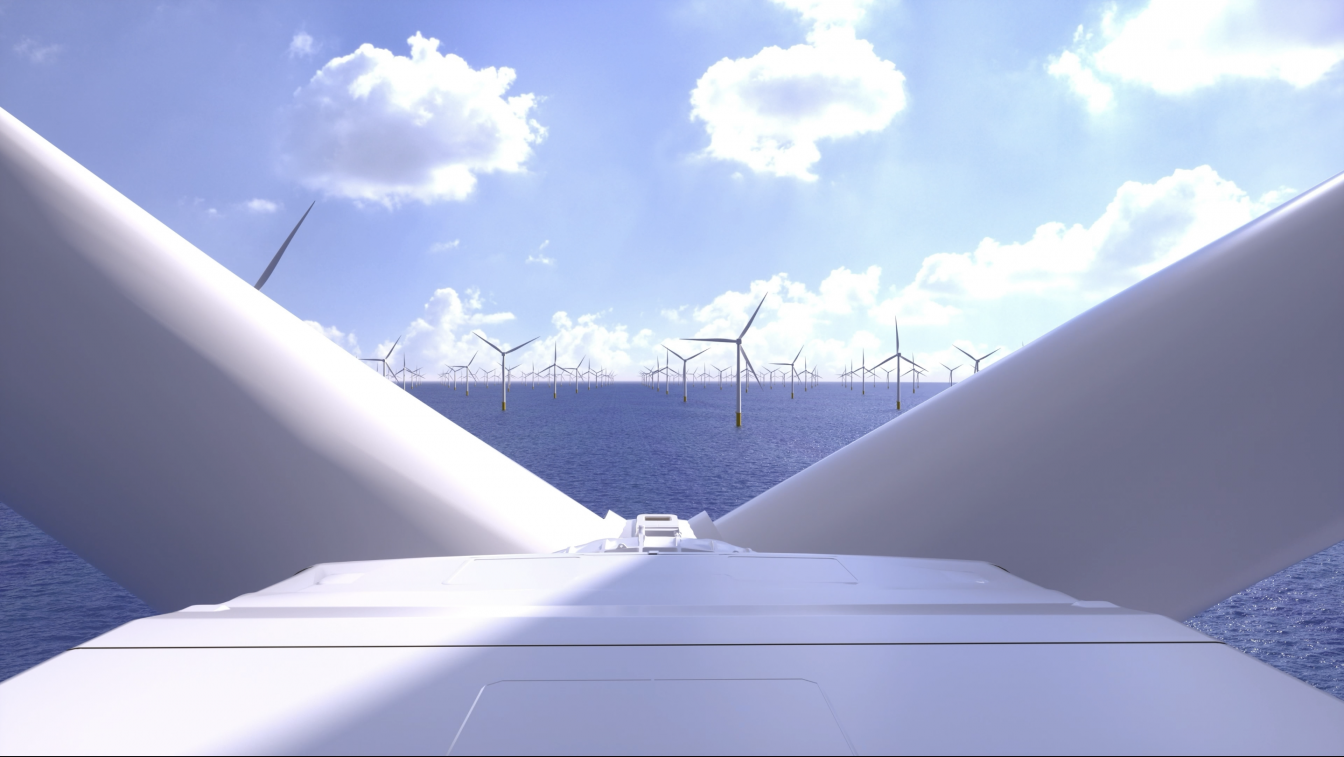
- Co-developers SSE and Equinor establish commercial terms of a proposed Dogger Bank C lease variation to progress Dogger Bank D, subject to the final outcome of The Crown Estate’s Capacity Improvement Programme and associated plan-Level Habitats Regulation Assessment (HRA).
- Up to 2GW Dogger Bank D project is the proposed fourth phase of 3.6GW Dogger Bank Wind Farm
- Project development proposes to maximise capacity from eastern part of Dogger Bank C seabed lease area in a move that can make the world’s biggest offshore wind farm even bigger
- SSE and Equinor each own 50% of the proposed Dogger Bank D development
SSE and Equinor, co-developers of the proposed Dogger Bank D fourth phase of Dogger Bank Wind Farm, have established commercial terms with The Crown Estate around an amendment to the existing Dogger Bank C seabed lease. This is subject to the outcome of the Plan-Level Habitats Regulation Assessment (HRA) that is associated with The Crown Estate’s wider Capacity Improvement Programme.
These preliminary terms mark a new milestone in the delivery of a proposed fourth phase of the world’s largest offshore wind farm, the 3.6GW Dogger Bank Wind Farm currently under construction off the coast of Yorkshire, England, in the North Sea.
Announced in 2023, Dogger Bank D has a potential capacity of up to 2GW of new renewable energy for the UK energy system which would be generated from maximising the capacity of the eastern portion of the Dogger Bank C seabed lease area. The move would make Dogger Bank, the world’s biggest offshore wind farm being built off the UK, even bigger.
The Dogger Bank D project is one of seven offshore wind farm projects in development which were identified for potential increases in generating capacity when The Crown Estate announced the Capacity Improvement Programme in November 2023 to unlock up to 4GW of potential new green electricity production. The capacity increases under consideration are within areas where seabed leasing agreements are already in place.
Before a final decision is taken on the Capacity Improvement Programme, The Crown Estate is required to undertake a plan-Level Habitats Regulation Assessment (HRA) in order to assess the implications of the Programme for protected habitats. The HRA seeks to understand the collective environmental impact of the additional capacity across all seven projects.
The commercial terms established by project shareholders SSE and Equinor with The Crown Estate lay the groundwork to progress Dogger Bank D subject to the satisfactory outcome of the HRA and, if Dogger Bank D is progressed, subject to any additional provision which may need to be made to secure mitigation or compensatory measures in light of the findings of the HRA.
Rob Cussons, Dogger Bank D Project Director at SSE Renewables, said:
“I am delighted the shareholders in Dogger Bank D have been able to establish commercial terms to amend the Dogger Bank C lease with The Crown Estate, subject to the outcome of the Plan Level HRA and The Crown Estate’s final decision on the Capacity Improvement Programme. It is a move that can unlock the value of more clean energy from the same area of seabed, as we accelerate towards a greener and more secure energy system. This pioneering project is made possible by the joint foresight from shareholders SSE and Equinor along with The Crown Estate to consider an innovative approach to bring forward more clean and secure energy from the available seabed, whilst ensuring that sensitive marine habitats are protected. And in doing so we can make the world’s biggest offshore wind farm even bigger.”
Halfdan Brustad, Equinor’s VP UK Renewables said:
“Reaching this milestone through close collaboration with our partner and The Crown Estate will help support the UK Government’s offshore wind and net zero ambitions, whilst building a competitive UK industry. Following first power, Dogger Bank, the world’s largest offshore wind farm, is a key example of what the offshore wind industry can offer, from security of electricity supply to economic growth and long-term jobs.”
The proposed Dogger Bank D project would connect to the national electricity infrastructure network at National Grid’s planned new 400kV substation at Birkhill Wood in East Riding of Yorkshire.
The project would require a new Development Consent Order to progress into construction. Initial consultations have been held with stakeholders, with further activities being planned for later in 2024.
Dogger Bank Wind Farm was awarded rights in The Crown Estate’s Offshore Wind Leasing Round 3 and is under construction in three phases: A, B and C. Dogger Bank Wind Farm is a joint venture between SSE Renewables (40%), Equinor (40%) and Vårgrønn (20%).
28th June 2024 in Press releases
- SSE and Equinor submit Scoping Report to The Planning Inspectorate for proposed fourth phase of Dogger Bank Wind Farm
- Report supports a request for a formal Environmental Impact Assessment (EIA) Scoping Opinion
- Project development made possible by opportunity to maximise capacity from eastern part of Dogger Bank C site
- Up to 2GW project would connect into new 400kV substation located in East Riding of Yorkshire
- SSE and Equinor each own 50% of the proposed Dogger Bank D development
SSE and Equinor, co-developers of the proposed Dogger Bank D fourth phase of Dogger Bank Wind Farm, have submitted a Scoping Report for the project to The Planning Inspectorate.
This follows publication in March 2024 by National Grid ESO of the Transitional Centralised Strategic Network Plan (tCSNP2) which included confirmation that Dogger Bank D will connect into Birkhill Wood, a proposed new 400kV substation located in the East Riding of Yorkshire*.
Developed as a 50/50 joint venture between SSE Renewables and Equinor, Dogger Bank D would, if consented and approved for delivery, have an installed capacity of up to 2GW and be located in the North Sea around 210km off the northeast coast at its closest point to shore. Project development has been made possible by the opportunity to maximise the capacity from the eastern part of the current Dogger Bank C site. Dogger Bank D is working closely with The Crown Estate, who manage the seabed around England, Wales and Northern Ireland to agree the progression of Dogger Bank D.
The existing 3.6GW Dogger Bank Wind Farm was granted development consent in 2015 and is currently under construction in the North Sea across three build-out phases, Dogger Bank A, B and C. Once complete, Dogger Bank Wind Farm will be the world’s biggest offshore wind farm in operation.
The proposed fourth phase of the wind farm, Dogger Bank D, has been designated a Nationally Significant Infrastructure Project (NSIP) of more than 100MW of generating capacity. As a result, an Environmental Impact Assessment (EIA) is required for the project to be able to submit a Development Consent Order (DCO) application.
The purpose of the Scoping Report is to request a formal EIA Scoping Opinion from the Planning Inspectorate which would outline the topics to be assessed in the EIA.
“The Scoping Report is an important milestone for Dogger Bank D and is a key part of the development of an offshore wind farm. The report lays out the scope of the project proposals and identifies key environmental factors. We look forward to receiving a Scoping Opinion from the Planning Inspectorate and input from consultees which will help inform our development proposals.”
Rob Cussons, Project Director for Dogger Bank D
A further round of public consultation on the proposals for Dogger Bank D will take place in Autumn 2024.
The Scoping Report is available to view on the Planning Inspectorate’s website.