10th March 2021 in Press releases, Project news, Supply Chain
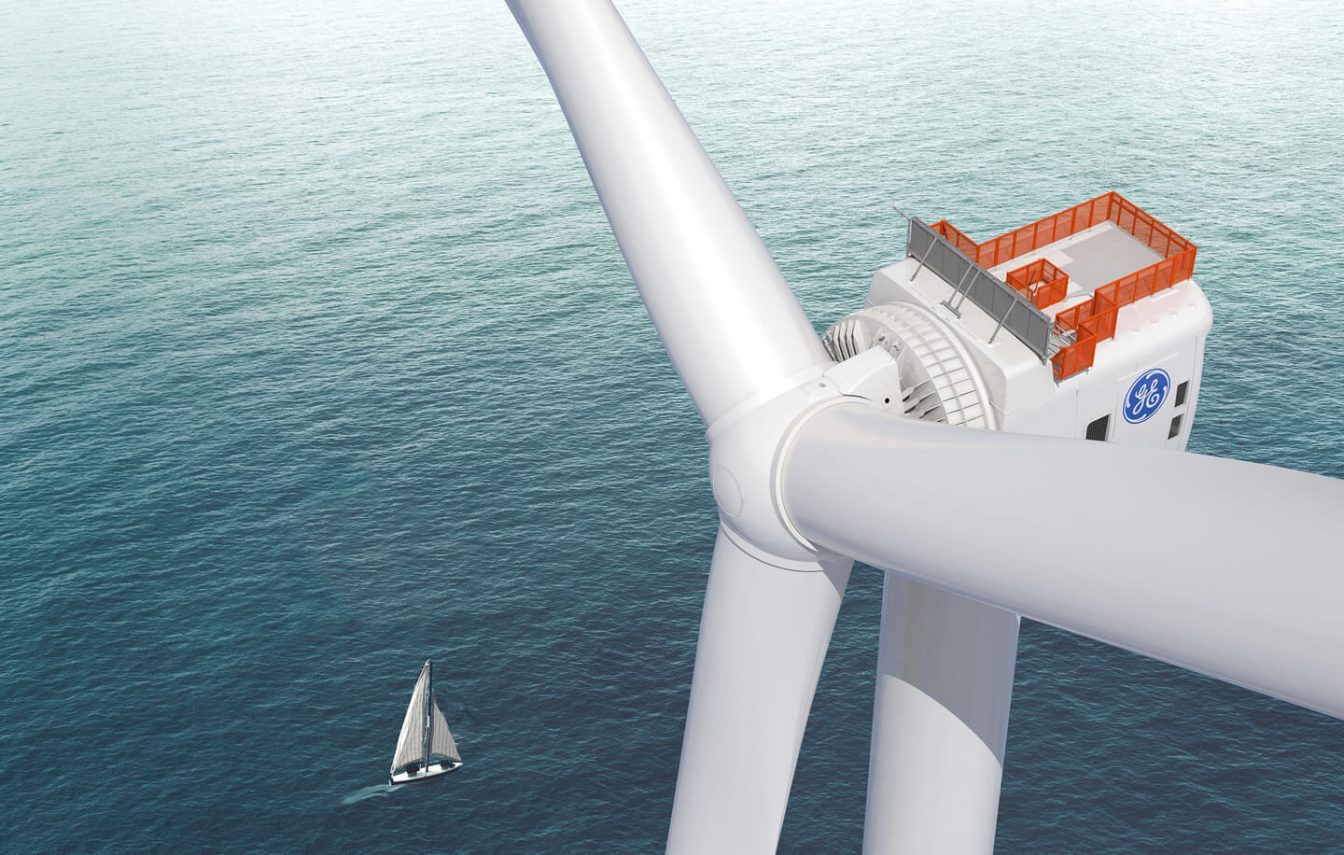
Blade factory is expected to create up to 750 direct and up to 1,500 indirect jobs in the region.
- Following significant order from Dogger Bank Wind Farm, LM Wind Power, a GE Renewable Energy Business, plans to open a brand-new manufacturing plant in the North East of England dedicated to the production of turbine blades for GE Renewable Energy’s Haliade-X
- The plant at Teesworks will produce sets of 107m blades for GE’s Haliade-X offshore wind turbine
- The Haliade-X turbines will be installed on Dogger Bank Wind Farm, more than 130km from the Yorkshire coast
- Blades produced in Teesside will be installed at Dogger Bank from 2024 onwards
- Today’s announcement brings the total number of jobs supported by the construction and operation of Dogger Bank Wind Farm in the UK region to more than 2,500
10 March 2021: GE Renewable Energy has today unveiled plans to open a new world-class blade manufacturing facility on Teesside in the North East of England to support the growing offshore wind market in the UK and Europe and to produce blades for its Haliade-X turbine that will power Dogger Bank, the world’s largest offshore wind farm.
The significant order of Haliade-X offshore wind turbines from Dogger Bank Wind Farm was a decisive factor in GE Renewable Energy’s decision to green light the new manufacturing plant, delivering a long-term renewable energy jobs boost to the region. The UK Government has also provided support to GE Renewable Energy to set up this new plant near Teesside as part of a greater effort to develop an industry and supply chain for the development of offshore wind in the country. This follows the designation of Teesside as one of the UK’s newest freeports.
Commenting on the investments it made for the new port of Teesside, UK Prime Minister Boris Johnson said: “Teesside will continue to drive forward our green industrial revolution as we capitalise on new opportunities to produce clean energy through a brand new offshore wind port on the River Tees. It will not only create thousands of jobs and harness the skills and expertise of this great industrial heartland, but also boost investment into the area as we build back greener.”
LM Wind Power, a GE Renewable Energy business, will set up and operate the state-of-the-art new facility at Teesworks, an ideal location to serve the vast offshore wind potential of the North Sea. It is anticipated the factory, which will start producing the 107-metre blades in 2023, will create up to 750 direct jobs, and around 1,500 indirect jobs, in the region. This brings the total number of new jobs supported by the construction and operation of Dogger Bank Wind Farm in the North East of England to more than 2,500 so far.
A substantial number of Haliade-X blades for Dogger Bank Wind Farm will be among the first orders to be delivered from the new manufacturing plant. Blades produced at Teesworks will be installed from 2024 onwards with the final number of blades from the plant destined for Dogger Bank to be confirmed in due course.
Dogger Bank Wind Farm Project Director, Steve Wilson, said: “We’re incredibly proud to say Dogger Bank Wind Farm is the anchor project for the blade facility announcement by GE today. Dogger Bank Wind Farm is a world-leading development pushing the boundaries of offshore wind development and playing a key role in delivering the ambition to increase UK supply chain capacity and capability. Through our turbine supply order with GE, the Dogger Bank project is the catalyst for this important GE investment in Teesside, harnessing skills and expertise in the local area and delivering long-term benefits in the UK’s offshore wind sector.”
Jerôme Pécresse, President and CEO of GE Renewable Energy said: “This new plant will contribute to the development of an industrial cluster dedicated to offshore wind in the North East of England. GE is delighted to be announcing a commitment to develop a new talent pool dedicated to renewable energy through the hiring and training of future employees at our new plant. The UK’s target to commission 40 GW of offshore wind by 2030 is ambitious and requires that we invest in local production capabilities to accompany this effort.”
Confirmation that part of the turbine blades for Dogger Bank Wind Farm will be manufactured in the UK delivers on a key commitment by the wind farm’s joint developers SSE Renewables, Equinor and Eni to support the development of a UK supply chain, creating substantial local jobs and maximising UK supply chain opportunities.
Alistair Philips-Davies, SSE Chief Executive, said: “As a UK-headquartered business we’re passionate about creating highly skilled and well-paid jobs here in Britain and using our purchasing power to support the indigenous supply chain. We’re delighted to play our part with Dogger Bank anchoring this multimillion-pound investment in Teesside by GE and creating hundreds of long-term green jobs in the north east. The UK is leading the world in offshore wind and the creation of this world-class manufacturing facility here on our shores will help drive this industry forward in the decade to come.”
Halfdan Brustad, Vice President for Dogger Bank at Equinor, said: “A project the size of Dogger Bank creates economic ripple effects, and with its operational base in the North East we are so pleased that our ground-breaking project has enabled this new blade manufacturing facility in Teesside to grow the UK offshore wind supply industry. Securing significant contracts with Dogger Bank enables suppliers to invest in the UK, creating jobs and supporting the industry’s ambition to increase local content. The global economy has been hit hard by the pandemic, but investment in offshore wind remains at a record high. Dogger Bank will not only generate renewable electricity for millions of homes across the UK, it also brings inward investment, and hundreds of highly skilled jobs.”
Alessandro Della Zoppa, Director Energy Solutions of Eni, said: “By participating in the Dogger Bank project, Eni is proud to contribute to the development of the UK offshore wind industry and world-class supply chain. For Eni, cooperating with the industry’s leading players for the deployment of highly innovative technologies is a great opportunity to progress in its transformation path towards green energy.”
GE’s Haliade-X is the most powerful offshore wind turbine in operation today. The Haliade-X 13MW turbine was confirmed for the first two phases of Dogger Bank Wind Farm in September 2020, with a record-breaking order for 190 of the innovative machines. GE Renewable Energy is preferred supplier for the third phase of Dogger Bank Wind Farm, where it will install its uprated Haliade-X 14MW. The agreement for Dogger Bank C will be finalised in the first quarter of 2021, confirming the order and number of turbines for the project’s third phase, and will be subject to Dogger Bank C reaching Financial Close in late 2021.
The three phases of the Dogger Bank Wind Farm will have a combined installed generation capacity of 3.6GW, enough to power six million UK homes. When complete in 2026, it will be the world’s biggest offshore wind farm.
The 2.4GW Dogger Bank A and B is a joint venture between SSE Renewables (40%), Equinor (40%) and Eni (20%). The A and B phases of the Dogger Bank Wind Farm reached financial close in November 2020 at competitive terms underlining the attractiveness of the UK offshore wind assets and the confidence in the joint venture. The 1.2GW third phase of the wind farm, Dogger Bank C, is a 50:50 joint venture between Equinor and SSE Renewables and is being developed under a different timeline.
SSE Renewables is leading on the construction and delivery of all three phases of Dogger Bank Wind Farm. Equinor will operate Dogger Bank Wind Farm on completion.
The electricity generated by the turbines at Dogger Bank, which are between 130km and over 200km from shore, will be transmitted onshore via subsea cables. Due to the distance of each of the Dogger Bank phases offshore, it will be the first wind farm in the UK to utilise an HVDC connection. The use of an HVDC connection will ensure the renewable energy being transmitted over the long distances from the Dogger Bank offshore to the onshore grid connections in England’s East Riding and Teesside will be achieved efficiently while minimising losses.
Ends
Picture caption: Following a significant order from Dogger Bank Wind Farm, LM Wind Power, a GE Renewable Energy Business, plans to open a brand-new manufacturing plant in Teesside dedicated to the production of turbine blades for GE Renewable Energy’s Haliade-X offshore wind turbines which will be installed at Dogger Bank. The plan will create up to 750 direct jobs, and around 1,500 indirect jobs, in the region. Today’s announcement brings the total number of jobs supported by the construction and operation of Dogger Bank Wind Farm in the UK region to more than 2,500. Picture source: GE Renewable Energy.
For further information:
Media contact – Dogger Bank Wind Farm:
Jason Cooke, SSE Renewables
Jason.cooke@sse.com
+353 (0) 86 264 6710
Media contact – Dogger Bank Wind Farm:
Rachel Lawrence, SSE Renewables
rachel.lawrence@sse.com
+44 (0) 7385 368783
Media contact – GE Renewable Energy:
Sebastien Duchamp
sebastien.duchamp@ge.com
+33 6 73 19 59 64
17th February 2021 in Press releases, Project news, Supply Chain

- Hitachi ABB Power Grids to install HVDC Light® technology to connect the transmission link on all three phases of Dogger Bank Wind Farm, making it the UK’s first HVDC-connected windfarm.
- Aibel to provide the offshore platforms for Dogger Bank A, B and C.
17 February 2021: Dogger Bank Wind Farm, Aibel and Hitachi ABB Power Grids are today announcing contracts to provide the offshore platform and associated transmission link for the third phase of the world’s largest offshore wind farm.
The two suppliers, which were previously appointed as tier one suppliers for the first two phases of Dogger Bank Wind Farm, are now confirmed for all three phases of the development, Dogger Bank A, B and C.
Both contracts are subject to financial close on Dogger Bank C, which is currently forecast for Q4 this year.
Dogger Bank Wind Farm has been developed as a joint venture between SSE Renewables and Equinor (50:50), and ENI will take a 20% stake in the first two phases, subject to regulatory and lender approvals of Eni’s agreement to enter the joint venture which are due during Q1 2021.
Dogger Bank Wind Farm Project Director, Steve Wilson, said: “Confirmation of our collaboration with Hitachi ABB Power Grids and Aibel on all three phases of Dogger Bank Wind Farm is another important milestone for our world-leading development. Working together in an integrated way will enable us to achieve optimum efficiency during the design, procurement and construction work, while the use of market-leading HVDC technology will ensure efficient and reliable transmission of renewable energy for 6 million UK households once all of the windfarm phases become operational.”
The electricity generated by the turbines at Dogger Bank, which are between 130km and over 200km from shore, will be transmitted onshore via subsea cables. Due to the distance of each of the Dogger Bank phases offshore, it will be the first HVDC connected wind farm in the UK. An HVDC connection will ensure the renewable energy being transmitted over the long distances from the Dogger Bank offshore to the onshore grid connections in East Riding and Teesside, will be achieved efficiently while minimising losses.
Hitachi ABB Power Grids will install its compact high-voltage direct-current technology, called HVDC Light®, for efficient transmission to the project’s onshore grid connections in the East Riding of Yorkshire for Dogger Bank A and B, and on Teesside for Dogger Bank C.
Aibel will work alongside Hitachi ABB Power Grids to provide the offshore converter platforms located in the North Sea.
“Together, with customers and partners, we are playing a key role in accelerating the energy transition,” said Niklas Persson, Managing Director of Hitachi ABB Power Grids’ Grid Integration business. “HVDC technology contributes significantly towards a carbon-neutral energy future by enabling the integration of large-scale and remote renewable energy generation,” he added. “Being selected once again underlines our customers’ trust in our world-leading expertise and delivery capabilities.”
“Alongside our partner Hitachi ABB Power Grids, our skilled engineers have developed integrated solutions and established an efficient supply chain for our deliveries. We are proud to see that our concept wins in a very competitive environment,” says Executive Vice President for Field development and Offshore wind in Aibel, Nils Arne Hatleskog.
Ends
Picture caption: An artist impression of an offshore wind farm with an Aibel convertor platform Picture source: Aibel
For further information:
Media contact – Dogger Bank Wind Farm: Rachel Lawrence, SSE Renewables rachel.lawrence@sse.com
+44 (0) 7385 368783
Rebecca Bleasdale, Hitachi ABB Power Grids Ltd.
Head of External Communications, Content & Media Relations
+41786432613
Rebecca.Bleasdale@hitachi-powergrids.com
Mona Winge, Aibel AS
Corporate Communication Manager
Direct: +47 85 27 41 02, Mobile: +47 98 67 55 11
mona.winge@aibel.com
15th February 2021 in Press releases, Project news
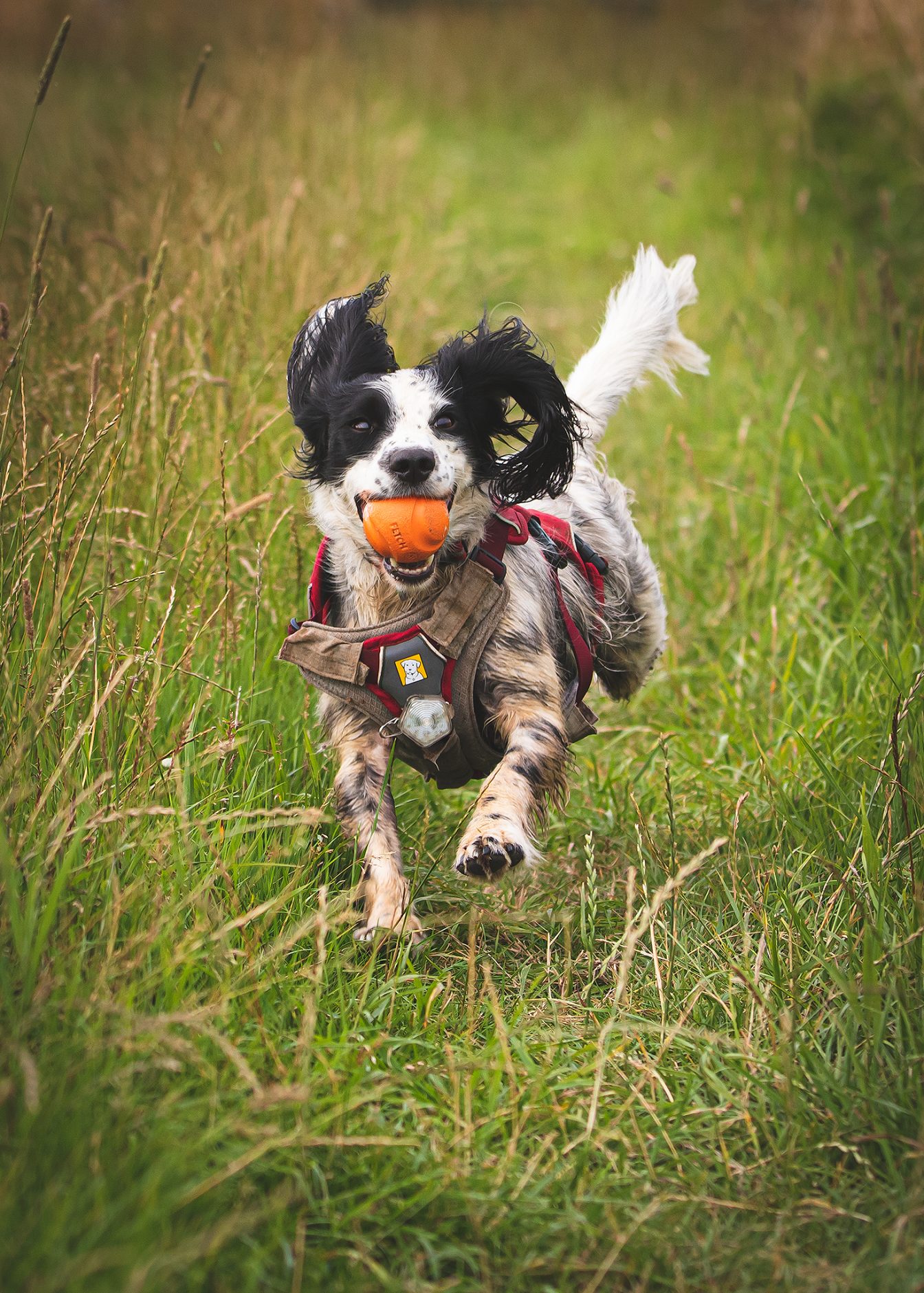
While technology is the answer to most of life’s challenges these days, the world’s largest offshore wind farm has been discovering there are times when only a four-legged friend will do.
The team at Dogger Bank Wind Farm has been going mutts for five-year-old Lola the Sprocker Spaniel, who’s been helping the project sniff out water voles on the 30km cable route in East Riding of Yorkshire.
Water voles are a protected species, commonly found living in watercourses and drainage ditches, and are similar-looking to the brown rat but with a blunt nose, small ears and a furry tail.
“As a responsible developer we use a range of techniques to identify wildlife along our construction routes, so we can take measures to protect them from harm,” explained Consents Team Manager Jonathan Wilson.
“This is the first time we’ve used specially-trained ecology dogs on our sites and Lola was certainly very popular with our on-site team. She positively identified three areas where water voles were present, especially in the hard-to-reach areas and with minimal disturbance to the surrounding habitat.
“Now we’ve found them, our water vole specialist is able to ensure the voles are kept safe during our construction activities following strict guidance under a licence issued by Natural England.
“After the work has finished and we’ve moved on, we would normally expect the water voles to continue life as before.”
Who says you can’t teach an old dog new tricks?
Detection dogs have been widely used for a number of years to find substances, with their acute sense of smell. But their use in detecting water voles is something that’s only been developed in the last seven years, and was pioneered by Ecologist Dog Handler, Ali Charnick.
“I’ve been training and working with water vole detection dogs for the last seven years and I have to say Lola particularly enjoys this work. She can cover large areas really quickly and efficiently,” explained Ali, from Ecology Dogs, the world’s only provider of this service.
“She’s an active Spaniel and loves to work, has an incredibly good nose and finds the work fun and easy. Her tail doesn’t stop wagging when she’s working and of course she gets a lot of welcome attention from the teams we work with.
“Lola and I have worked on other sites and in similar habitats in Yorkshire, but we’ve never worked on the world’s largest offshore wind farm so that’s very exciting for us and very nice.
“I’m a self-confessed renewable energy nerd too so I was very excited when I got asked to work on it. From a personal point of view it’s been a real privilege.”
Using the most powerful turbines in operation and generating renewable energy for 6 million UK households, Dogger Bank Wind Farm is far from an underdog. In fact these world-leading turbines have blades as long as nine and a half buses back-to-back, and can generate enough renewable electricity to power a UK home for over two days, with just one spin. Find out more about our record-breaking turbine order here.
13th January 2021 in Press releases, Project news
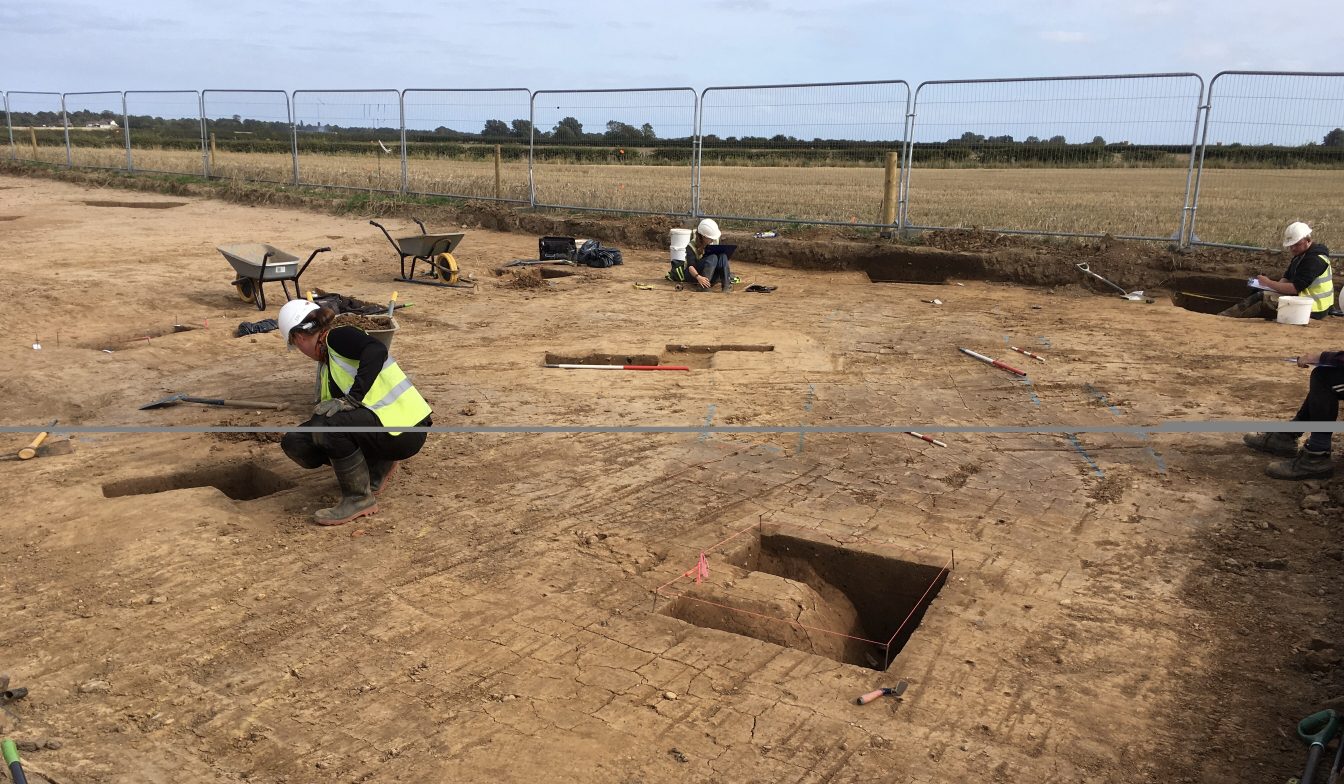
Fragments of long-forgotten Roman and Iron Age moments in history have been unearthed by archaeologists working on the Dogger Bank Wind Farm.
Specialists from AOC Archaeology Group have been carrying out extensive excavations along the cable route in East Yorkshire, for the first two phases of the project since 2018, and are now starting to build a picture of life on the land thousands of years ago.
“So far we’ve found a lot of Iron Age and Roman archaeology, including evidence of rural settlements, enclosures and field systems,” explained Stephen Potten, who manages AOC Archaeology’s York office and is leading the work.
“There’s some structural evidence that may relate to buildings and considerable quantities of domestic pottery. The Dogger Bank project is certainly giving us a great opportunity to gain a better understanding of Iron Age and Roman settlements in the area.
“We’ve always known there were settlements in this area but our excavations are shedding more light on how extensively the area was occupied and how communities interacted with the landscape. The evidence we’ve unearthed suggests that the area was home to busy, thriving communities during the Iron Age and Roman periods.
“As well as pottery, a number of settlements have produced ironwork, animal bone and some evidence of industrial work too. This material helps us to understand what activities were taking place in the Iron Age and Roman periods, and how widespread they were.
“We’ve found some fantastic Roman pottery, often just discarded in ditches and pits. All these artefacts are now in the process of being cleaned and examined by specialists, who’ll be able to tell us if there are any unusual or rare forms and perhaps help us identify any high-status objects. It’s also possible some of the pottery was imported, and this could tell us a lot about trade links and commerce thousands of years ago.”
Archaeological work is set to continue at locations along the Dogger Bank A & B cable route into 2021.
Dogger Bank Wind Farm Consents Team Manager Jonathan Wilson, said: “The archaeological work taking place on the Dogger Bank Wind Farm cable route is a vital part of our work as a responsible developer. It is a great privilege to be able to unearth this fascinating history of the area as we work to build the world’s largest offshore wind farm, which will provide renewable energy for 6 million UK homes.”
About Dogger Bank Wind Farm:
- Dogger Bank Wind Farm will be the world’s largest offshore wind farm when completed in 2026.
- It is being built in three phases: Dogger Bank A, B and C.
- Dogger Bank A and B is a joint venture between SSE Renewables (40%), Equinor (40%) and Eni (20%). Dogger Bank C is a 50:50 joint venture between SSE Renewables and Equinor.
- SSE Renewables is lead operator for the development and construction of Dogger Bank Wind Farm. Equinor will be lead operator of the wind farm for the duration of the wind farm’s operational phase
- Financial Close on Dogger Bank A and Dogger Bank B was reached in November 2020. Financial Close for Dogger Bank C is expected in late 2021.
- Consent for Dogger Bank Wind Farm was granted in 2015.
- Dogger Bank Wind Farm is located in the North Sea, with each phase more than 130km from the Yorkshire Coast.
- Onshore construction began in 2020 and is currently underway for Dogger Bank A and Dogger Bank B, with offshore construction on Dogger Bank A due to begin in Q2 2022. First power is expected in Summer 2023 and Summer 2024 for Dogger Bank A and B, respectively, with commercial operations to follow around 6 months later.
- Turbine installation for Dogger Bank C will begin in 2025.
- A total of 320 skilled jobs for the North East of England associated with the development and operation of Dogger Bank Wind Farm have been announced so far.
- This includes 120 skilled jobs at marshalling harbour Able Seaton Port in Hartlepool during construction, and 200 skilled jobs to be based offshore and at the Port of Tyne for Operations and Maintenance of the wind farm once operational.
- Dogger Bank A and B has confirmed GE’s 13MW Haliade-X as the turbine powering the first two phases of the project. As the first order for the 13MW Haliade-X, installation at Dogger Bank A will be the first time the turbine is installed in the world.
- Dogger Bank C will install GE’s upscaled 14MW Haliade-X turbine.
- One rotation of the Haliade-X turbine blades can power one UK home for more than two days.
- The wind turbines will be installed on monopile foundations.
- The project will be the first High Voltage Direct Current (HVDC) connected wind farm in the UK due to its distance from shore.
11th December 2020 in Press releases, Project news
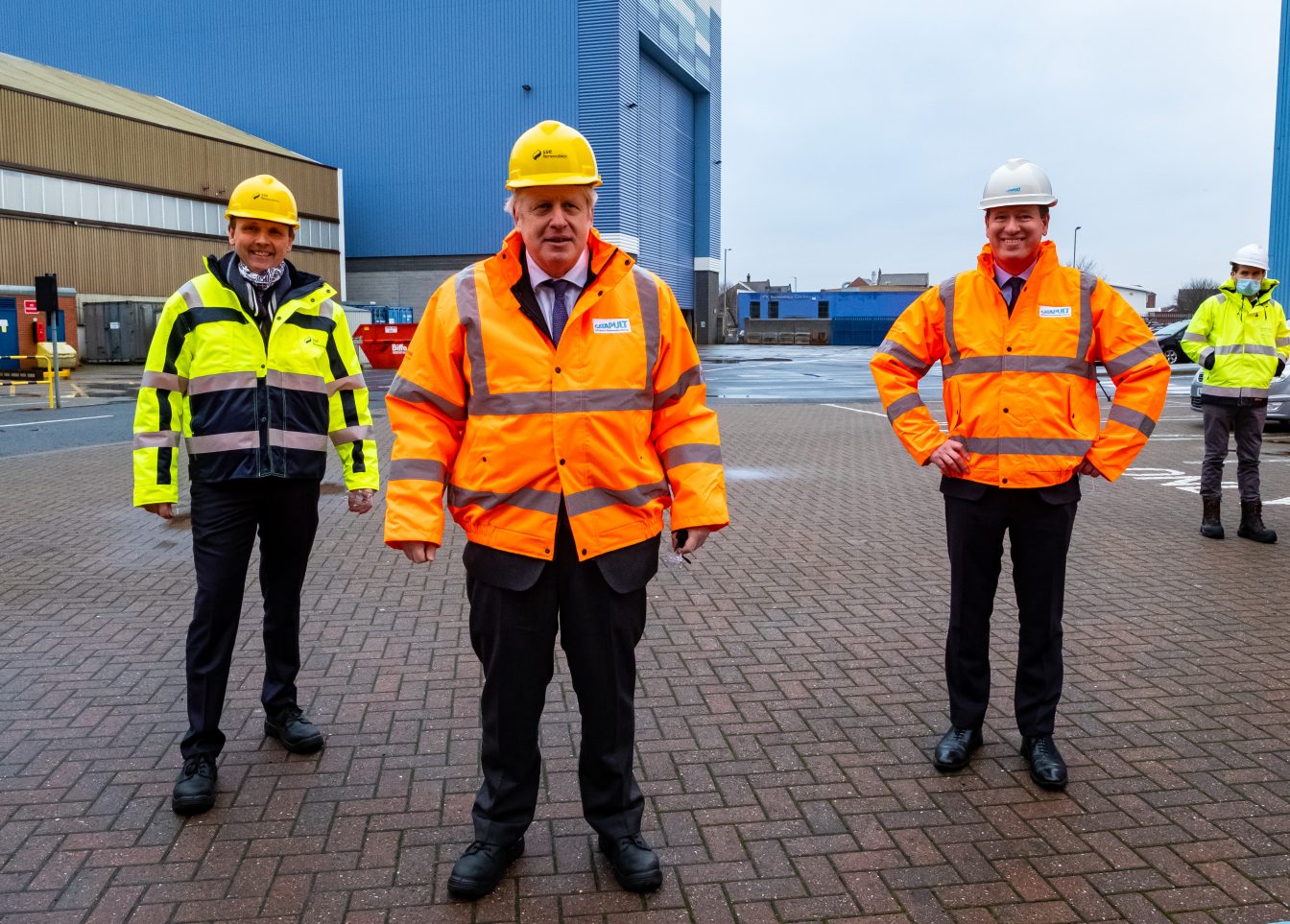
The UK Prime Minister has today praised the team behind the Dogger Bank Wind Farm for the role it’s playing in bringing jobs and investment to the north of England, while driving a green economic recovery.
Located over 130 km off the north east coast of England, Dogger Bank Wind Farm is pioneering new technology.
It will be the first project to use the largest commercially available turbine in the world, GE Renewable Energy’s 13MW Haliade-X, and due to its distance from shore, the first UK High Voltage Direct Current connected wind farm.
In a visit to the ORE Catapult, in Blyth, Northumberland, the Prime Minister said Dogger Bank Wind Farm would bring high quality jobs and investment and drive economic recovery. With a focus on skills and opportunities for young people he said the site was central to the UK’s power future, generating jobs and growth for years to come.
When fully completed in 2026, each phase of Dogger Bank Wind Farm will be able to produce 6TWh of renewable electricity, totalling 18TWh annually – enough to supply around 5% of the UK’s demand and equivalent to powering six million UK homes each year.
ORE Catapult’s world-leading facility is currently testing GE’s record-breaking turbine, ahead of its installation on Dogger Bank Wind Farm. SSE Renewables and Equinor will install 190 of the innovative turbines in the first two phases of the development.
Dogger Bank Wind Farm Project Director, Steve Wilson, said: “Dogger Bank Wind Farm demonstrates innovation and ambition never before seen in the offshore wind industry, using the world’s most powerful wind turbines in operation, GE’s 13MW Haliade-X. To have this recognised by the UK Prime Minister is a tremendous boost for our highly-skilled team, who’ve worked so hard during the pandemic to keep the project on track to supply more than 6 million UK homes from 2026.
“ORE Catapult’s Blyth testing facility is playing a critically important role in the development of Dogger Bank Wind Farm. The Prime Minister was visibly impressed with the expertise he encountered there, as well as the scale of GE’s giant turbine blades and nacelles.
“The Prime Minister clearly recognises the importance of our project in the green economic recovery of the UK, as we create the jobs that will boost the economy and the renewable energy that will significantly contribute to his net zero targets in our post-COVID world.”
Chief Executive of the Offshore Renewable Energy Catapult, Andrew Jamieson, said “Through our collaboration with GE Renewable Energy and LM Wind Power, the Catapult’s world leading test and validation facilities in Blyth are pivotal to delivering Haliade-X, the world’s leading offshore wind turbine, to Dogger Bank Wind Farm. As importantly, they are also at the heart of an extensive programme of UK academic research and innovation, supporting the growth of the UK supply chain and SMEs delivering the vital technologies to meet our net zero commitments and fuel the green economic recovery.
“We’re really pleased to see SSE Renewables and Equinor taking a world leading role in delivering Dogger Bank Wind Farm and adopting the breakthrough technologies of GE’s Haliade-X”.
Olivier Fontan, CEO of LM Wind Power, which is part of GE Renewable Energy, said: “It was a pleasure to show the Prime Minister GE’s world-leading Haliade-X, the world’s largest offshore wind turbine in operation today. The perfect technology for the world’s largest offshore wind farm at Dogger Bank. A single sweep of the Haliade-X blades will be able to power the average UK household for more than two days. Testing a blade of this size and complexity, at the ORE Catapult in Blyth, is a tremendous technological achievement.”
About Dogger Bank Wind Farm:
- Dogger Bank Wind Farm will be the world’s largest offshore wind farm once complete.
- It is being built in three phases: Dogger Bank A, B and C.
- Dogger Bank Wind Farm is a Joint Venture between SSE Renewables and Equinor:
– When the transaction to sell a stake in the project to Eni completes in Q1 2021, the new shareholding in Dogger Bank A and B, will be SSE Renewables (40%), Equinor (40%) and Eni (20%)
– Dogger Bank C remains a 50:50 joint venture between SSE Renewables and Equinor.
- SSE Renewables is lead operator for the development and construction of Dogger Bank Wind Farm.
- Equinor will be lead operator of the wind farm for the duration of the wind farm’s operational phase of up to 35 years
- Financial Close on Dogger Bank A and Dogger Bank B was reached in November 2020. Financial Close for Dogger Bank C is expected in late 2021.
- Consent was granted in 2015.
- Located in the North Sea, with each phase more than 130km from the Yorkshire Coast.
- Onshore construction began in 2020, and offshore construction will begin with turbine installation for Dogger Bank A in 2023
- The first phase, Dogger Bank A, is expected to be operational in 2023. The wind farm is expected to be fully operational in 2026.
- A total of 320 skilled jobs for the North East of England associated with the development and operation of Dogger Bank Wind Farm have been announced so far.
- This includes 120 skilled jobs at marshalling harbour Able Seaton Port in Hartlepool during construction, and 200 skilled jobs to be based offshore and at the Port of Tyne for Operations and Maintenance of the wind farm once operational.
- Dogger Bank A and B has confirmed GE’s 13MW Haliade-X as the turbine powering the first two phases of the project, representing the first-ever install of what is the world’s largest wind turbine.
- One rotation of the Haliade-X 13MW blades can power one UK home for more than two days.
- The wind turbines will be installed on monopile foundations.
- The project will be the first High Voltage Direct Current (HVDC) connected wind farm in the UK due to its distance from shore.